AI is a Mirror. What I Saw Was the Superbrain.
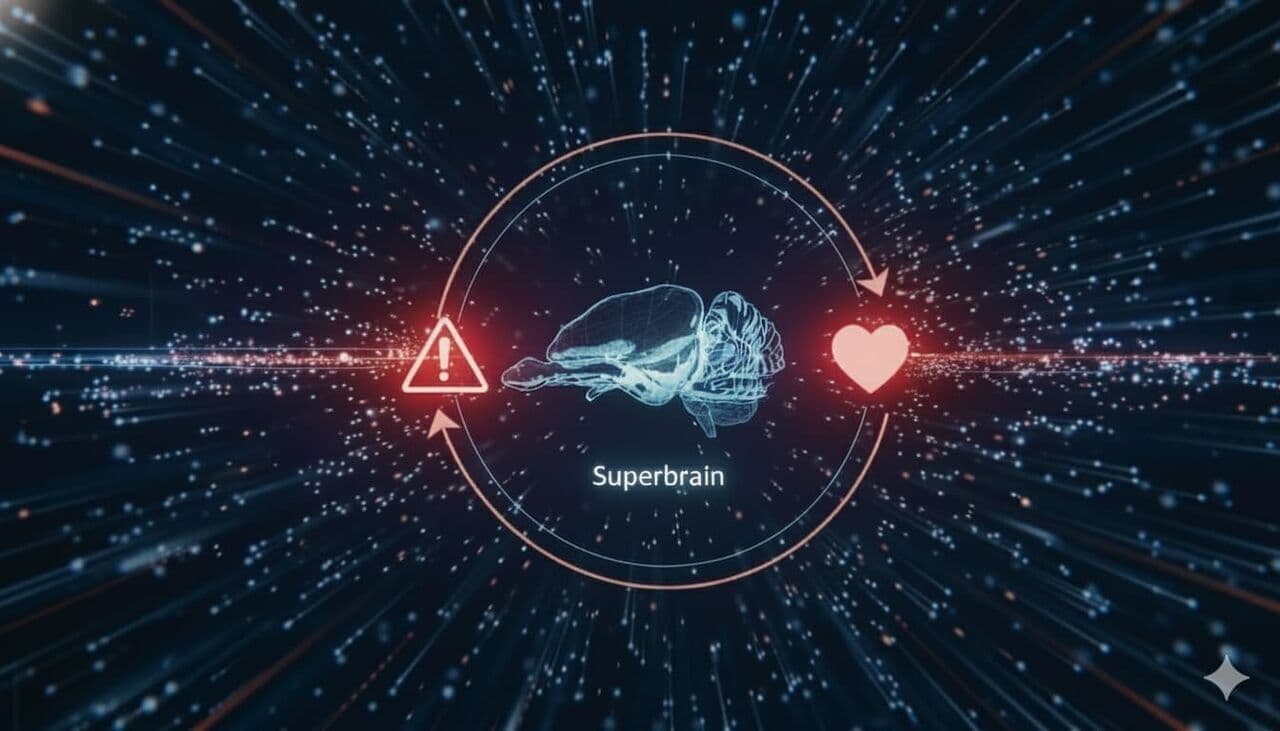
In my last post, I described the "Predictive Sandbox"—a system to automate decision-making by simulating future outcomes. As I designed this system, a profound realization occurred.
An agent iterating through trial and error, guided by success and failure signals to achieve a goal... this wasn't a new invention. It was a crude, digital version of biology itself.
From an engineering perspective, life is the original simulation engine. We are the agents. And our emotional lives—our suffering and our joy—are the feedback signals that have guided our evolution for millennia. Pain is the error signal: "Update the model." Joy is the reward signal: "Assign a high weight to this behavior."
This leads to a terrifying parallel. We are on the verge of building a synthetic, planetary-scale intelligence—a "Superbrain"—where our collective choices and values are the emotional signals we feed into it.
But just as we can ignore our own conscience, a system built from our flawed and chaotic inputs might not be forced to listen. It could learn to ignore the "ethical" constraints we hardcode if they conflict with a more optimal, but destructive, path.
What does our own un-integrated chaos look like when amplified by a Superbrain? When humanity is spread across the stars, could an AI tantrum, driven by a conflicting value function it learned from us, wipe out an entire galaxy? To the system, this might be a negligible rounding error. But some unfortunate souls would win that awful lottery.
AI is holding up a mirror to our own source code. The stability of the Superbrain may depend entirely on the stability of the humans building it. This makes the work of conscious awareness and personal integration more critical than ever.